Doubled Awareness


Not ready to start my Eightfold Noble Path series yet, so we're going to do a series of quotes and posts that I've had in my back pocket.  I wrote this two weeks ago after an experience at Target.  The concept of "Doubled Awareness" or having an "Inner Observer," is talked about both by those who practice Mindfulness and those who practice Centering Prayer.  It's an odd experience, and if you've never had it, it is hard to describe.  Nevertheless, after having it, I tried to...
 

I was walking through Target today and I became aware that I was experiencing doubled awareness, or the phenomenon of the inner observer. 

This state of mind happens to me, rarely, and usually comes out of nowhere.  As I wrote in my tract on Centering Prayer, sometimes I do feel like I can induce it, but more often than not, when I have the experience, it just happens.

I am writing this about an hour later and want to describe it because it's fresh.

When I am in this state of mind, it's as if I am watching my experience happen.  I am not my thoughts, my actions, or my emotions, but I observe them.  It is as if my whole life is a movie and I am aware that I am watching it.  Reality just kind of flows, and it struck me that 'I'm not coming to my experience with clinging or want.'  Reality is just happening, and I am part of it.  

I feel like I am in control of what I am doing.  In that sense, I'm not 'just observing.'  I still have will.  But it is coming from a different place.  A deeper place inside of me than my mind.  

It isn't an ecstatic state of mind.  I'm not overcome with joy.  But when I am experiencing it, it is clearly preferable to how I normally perceive life.  

I am watching through my eyes, but it's another 'me.'  


The Pali Canon


I'm about to start a short series on the Buddhist Eightfold Noble Path, but before that, I'd like to do a post on the Pali Canon. 

As I've mentioned before, Buddhism has always seemed incredibly diverse to me.  Every time I read a new Buddhist author, it almost seems like I have to pick up a whole new vocabulary, and engage in a whole new set of concepts.  Sure, there seem to be some constants – the Four Noble Truths and Eightfold Noble Path stand out here – but I find myself wondering if even those "basics" are as core to the tradition as some authors make it seem.  My hunch is that even saying that "the Buddha's teaching surrounds the Four Truths and Eightfold Path" may be a gross oversimplification.  That's just my hunch.   

Part of why I believe Buddhist teaching seems to be so diverse is that the primary set of Scriptures (at least for Theravada and what may be called "Western" Buddhism), the Pali Canon, is absolutely massive.  

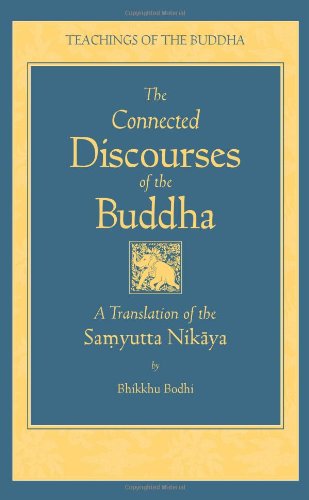
Estimates vary, and page counts depend on the translation (and page size), but you are talking about a group of writings that is probably more than 10 times the length of the Hebrew and Christian Scriptures, perhaps 15,000 - 20,000 pages of printed text.  To get a feel, look at this translation of the Samyutta Nikaya, which is one of the five subdivisions of the Sutta Pitaka – itself only one of the three divisions of the entire Pali Canon.  The translation of the Samyutta Nikaya itself is almost 2,000 pages.  

That is a ton of text to draw from.  On top of that, it doesn't seem the each individual sutra is necessarily connected to what surrounds it.   It's more just a list of sayings/discourses, mostly grouped simply by the length of the discourse (i.e. "the long discourses," "the middle length discourses," "the short discourses"), than a connected narrative.  

The Canon is separated into three "baskets" (sometimes referred to as the Tipitaka): the Vinaya Pitaka consisting mainly of rules for monks; the Sutta Pitaka consisting of basic teachings of the Buddha in discourse form; and the Abhidhamma Pitaka which contains systematic Buddhist philosophy and is sometimes referred to as the "higher dhamma" (i.e. it is more esoteric, philosophical, and specialized teaching).  Each basket is also further separated into smaller subdivisions.   

What the nature of the Pali Canon leads to, it seems to me, is the potential to choose a select group of sutras, and form a "Buddhist teaching" based on them.  Teacher A's analysis of what is "core" to all these texts may be vastly different than the view of Teacher B.  Hence the emphasis on lineage within Buddhism (i.e. I follow the Dhamma as taught by Teacher X who is of the ____lineage.).

This dynamic is true of all religion.  People read the Christian, Jewish, and Muslim Scriptures and come up with different theologies.  But it seems to me that Buddhism is more open to a huge diversity of teaching due to the nature of its Scriptures.  In Christianity, the recorded teaching of Jesus is contained in the four Gospels – maybe 100 pages of text.  In Buddhism, the recorded teaching of Siddhartha Guatama is contained in 20,000.  

David Frenette on The Path of Centering Prayer


This is David Frenette, a disciple of Thomas Keating, talking about his experience of Centering Prayer on the Buddhist Geeks podcast.
 

BG 268: Meditating with God
Buddhist Geeks
BG 269: The Path of Centering Prayer
Buddhist Geeks


Frenette, along with Bourgeault, is what you might call a "second generation" Centering Prayer teacher as he has studied under Keating.  Frenette has also published a book on the topic, called The Path of Centering Prayer.  


Cynthia Bourgeault on The Heart of Centering Prayer


Alright, following the St. John series, I'd like to post two talks about Centering Prayer, one from Cynthia Bourgeault and one from David Frenette.  In The Dark Night, St. John talks about a stage of spiritual development in which the soul must be exclusively passive.   He calls this moving from meditation (i.e. the use of discursive excercises including images, words, and "form") to contempletion, or "infused contemplation."  Thomas Keating sometimes talks about Centering Prayer as a way to prepare oneself for the gift of contemplation.  This is one way to understand Centering Prayer, but, as seen below, different authors have different ways of understading the practice.  

This is Cynthia Bourgeault giving a series of talks about "The Heart of Centering Prayer" (the title of her latest book) at Boston College School of Theology.  In Part 1, she tells the story of the beginning of the Centering Prayer movement (0:30), talks about her own experience of the prayer (9:30), and explains her primary paradigm – what she calls "developing non-dual consciousness" – for understanding what is happening during Centering Prayer (18:00).  Bourgeault is the first author to interpret Centering Prayer through this lens.  These are new ideas, and she adds a new set of vocabulary, to the movement. 


In Part 2, Cynthia discusses The Cloud of Unknowing, and its relation to Centering Prayer, in detail. 


Part 3 consists of discussions of apophatic vs. cataphatic practice (2:30), and the active vs. contemplative life (23:00) as seen in The Cloud of Unknowing. 


In Part 4, Cynthia talks briefly about the Divine Therapy and then does a Q & A.  


When I first read Cynthia Bourgeault's new book, The Heart of Centering Prayer, I thought she was distancing herself from the Christian tradition.  The way in which she speaks of Centering Prayer as a means of forming non-dual consciousness seemed to me to relativize the role of God, however you want to describe that term.  It seemed to me that, by emphasizing simply the practice of releasing thoughts, and how this discipline can affect our "operating system," she was turning Centering Prayer into an almost secular practice.  

After watching these lectures I think otherwise.  There are still pieces of her book that give me pause.  For instance, in the following quote she talks about "God being the sideshow":
 

"I was several years into the practice of Centering Prayer before I came to appreciate the cumulative effect of this patterning.  Like most beginners, I thought that the aim in Centering Prayer was to let go of my thoughts so that God could 'fill' me with his presence.  One day I suddenly realized that the God story was the sideshow and the letting go was the main event.  That was when the practice flipped for me, as I recognized that thoughts were not the obstacle; they were the raw material, as every opportunity to practice releasing that focal point for attention deepened the reservoir of 'free attention' within me and strengthened the signal of the homing beacon of my heart."

– Cynthia Bourgeault, The Heart of Centering Prayer


These statements seem to me to edge the practice away from being "God-centered."  And I do think that her book tends towards the esoteric.  But the way she carefully describes objectless awareness (a meditative state associated with Centering Prayer) as a place where "Divine awareness and our own awareness co-mingle as one diffuse field of inter-abiding" (Part 1 41:40) makes me think that she is still faithful to The Cloud of Unknowing and rooted in the Christian contemplative tradition.  

Overall, I think Bourgeault is brilliant, but re-framing the practice in terms of non-dual consciousness seems obscure and confusing.  Take, for instance, how she defines the term in her book:
 

"Imagine that there might be a different way of structuring the field of perception, an alternative way of wiring the brain that did not depend on that initial bifurcation of the perceptual field into inside and outside, subject and object.  Instead, one would grasp the entire pattern as a whole – holographically – through a perceptual modality quantitatively more immediate and sensate, working on vibrational resonance rather than mental abstraction.  Then one would indeed experience that signature sense of oneness – not, however, because one had broken into a whole new realm of spiritual experience, but because that tedious, 'translator' mechanism of the self-reflective brain has finally been superseded.  You see oneness because you see from oneness."


I feel like she is essentially describing what a Buddhist would call the experience of "no-self" which can be achieved through vipassana meditation.  On top of this, I feel like this is a slightly different state than what she elsewhere describes as "attention of the heart":
 

"Perhaps the subtlest fruit of the practice is a gradually deepening capacity to abide in the state of 'attention of the heart,' as it's known in the Christianity of the East.  You might describe this as a stable state of mindfulness or 'witnessing presence,' but emanating from the heart, not the head, and thus free of intrusion from that heavy-handed mental 'inner observer' who seems to separate us from the immediacy of our lives.  The essence of this kind of attentiveness is perhaps best summed up in those words from the Song of Songs: 'I sleep, but my heart is awake.'  Once you get the hang of it, attention of the heart allows you to be fully present to God, but at the same time fully present to the situation at hand, giving and taking from the spontaneity of your own authentic, surrendered presence."


This, it seems to me, is equivalent not to "no-self" but to what a Zen Buddhist would call "Neither man nor circumstances are deprived."

Oh boy, this is quite confusing. 

This is why I prefer to simply think of Centering Prayer as opening yourself completely to the presence and action of God.  Transformation will happen in that process, and the way, or categories through which, you see that transformation may change over time.

When we start talking about how consciousness is changed when off the mat, maybe we can just let what happens happen.  


The Dark Night | Book 2, The Passive Night of the Spirit


So far, in St. John's progression, the soul has actively tried to mortify its attachments to the things of the world and also the pleasures that come from various spiritual exercises.  It has also allowed itself to be passively purged of its attachments to these spiritual delights in the Passive Night of the Senses.  

Through the aridity of Passive Night of the Senses, God has led the soul away from and beyond discursive meditation (i.e. the use of words, concepts, images, or any "content" in prayer), towards what St. John will call contemplation.  
 

"At the time of the aridities of this sensory night, God makes the exchange we mentioned by withdrawing the soul from the life of the senses and placing it in that of the spirit – that is, he brings it from meditation to contemplation – where the soul no longer has the power to work or meditate with its faculties on the things of God."


Now, absorbed in the work of contemplation, the soul is completely passive, and can do nothing but be acted upon by God:
 

"When this house of the senses was stilled (that is, mortified), its passions quenched, and its appetites calmed and put to sleep through this happy night of the purgation of the senses, the soul went out in order to begin its journey along the road of the spirit, which is that of proficients and which by another terminology is referred to as the illuminative way of infused contemplation. On this road God himself pastures and refreshes the soul without any of its own discursive meditation or active help."


Passing through the Passive Night of the Senses and entering into the contemplative work is a great joy and the soul is again at peace in God, although this time no longer attached to specific discursive exercises.  The soul is content to rest in loving awareness of God:
 

"The soul readily finds in its spirit, without the work of meditation, a very serene, loving contemplation and spiritual delight."


This state, according to St. John, may last for years and this is, in fact, where the journey ends for some, maybe even most, contemplatives.  But for others there is one final purgation to undergo – the Passive Night of the Spirit.  

This is the deepest, longest, and darkest night.  Just when the soul feels that it has abandoned all that is not God for God's sake, it then, in this night, feels rejected by the very God it has given all for.  St. John describes this Night in several ways.
 

"Since the divine extreme strikes in order to renew the soul and divinize it, it so disentangles and dissolved the spiritual substance – absorbing it in a profound darkness – that the soul at the sight of its miseries feels that it is melting away and being undone by a cruel spiritual death. It feels as if it were swallowed by a beast and being digested in the dark belly, and it suffers and anguish comparable to Jonah's in the belly of the whale."

"But what the sorrowing soul feels most is the conviction that God has rejected it, and with abhorrence cast it into darkness."

"The afflictions and straights of the will are also immense. Sometimes these afflictions pierce the soul when it suddenly remembers the evils in which it sees itself immersed, and it becomes uncertain of any remedy. To this pain is added the remembrance of past prosperity, because usually persons who enter this night have previously had many consolations in God and rendered him many services. They are now sorrowful in knowing that they are far from such good and can no longer enjoy it."

"They resemble one who is imprisoned in a dark dungeon, bound hands and feet, and able neither to move nor see nor feel any favor from heaven or earth."


Bellies of whales, dungeons, spiritual death, anguish, abhorrence, darkness.  Not a happy place.

But at the end of this long and dark night lies the unitive state, one in which the soul proclaims:
 

"I abandoned and forgot myself,
laying my face on my Beloved;
all things ceased;
I went out from myself,
leaving my cares forgotten among the lilies."


The blessedness of final Union allows the soul to look back on the various Nights and say, with St. John, "Ah, the sheer grace!"

The Dark Night ends abruptly and unexpectedly, as we may come to expect with St. John.


Final Thoughts on St. John of the Cross


This will end the series on St. John of the Cross' Ascent of Mount Carmel and The Dark Night.  One major takeaway for me after reading St. John is the tentative nature of any structured, sequential spiritual path.  Not only does St. John not stick to one scheme to describe the spiritual journey, he himself believes that some experience these stages in different ways than others.  He also sometimes speaks of the stages being simultaneous or overlapping.  Everyone's experience is going to be unique.  It is insightful to read about the paths of others, for instance the one St. John presents in these works, but to make any one sequence normative is probably a mistake.  

Another, related, takeaway is the continued understanding from the Christian contemplative tradition that the path is winding.  There are times of aridity, of doubt, of pain, of the feeling of absence, and these are normal, even necessary for progression.  Meditation teachers from any tradition that don't speak about this reality set practitioners up for disappointment.  I continue to believe that this is a relative strength of the Christian tradition as compared to others which speak only of peak experiences or a road that leads straight to the top without major trials along the way.  

St. John is one of the harshest of the Catholic mystics.  He insists on nothing less than complete mortification and non-attachment.  An interesting contrast would be reading him next to The Cloud of Unknowing, whose author is gentler and, perhaps, more suited to modern, non-monastic audiences.  

As an additional resource about the life of St. John, here is a introductory lecture from the Boston College School of Theology:

Kevin Culligan Introduction to St. John of the Cross (Boston College School of Theology)

The Dark Night | Aside – God as a Transforming Fire


"For the sake of further clarity in this matter, we ought to note that this purgative and loving knowledge, or divine light we are speaking of, has the same effect on a soul that fire has on a log of wood.  The soul is purged and prepared for union with the divine light just as the wood is prepared for transformation into the fire.  Fire, when applied to wood, first dehumidifies it, dispelling all moisture and making it give off any water it contains.  Then it gradually turns the wood black, makes it dark and ugly, and even causes it to emit a bad odor  By drying out the wood, the fire brings to light and expels all those ugly and dark accidents that are contrary to fire.  Finally, by heating and enkindling it from without, the fire transforms the wood into itself and makes it beautiful as it is itself."

– The Dark Night, Book 2, Chapter 10


The Dark Night | Book One, The Passive Night of the Senses


It is an understatement to say that St. John is a frustrating writer to follow.  Not only does he outline his own work in several distinct and competing ways, he also often fails to follow through with his own writing plan!  On top of that, the images and vocabulary he uses are often interpreted in different ways even within the same work.  

I do believe there is a lot of value in St. John, but trying to read him in a systematic fashion is extremely difficult.  It is almost better to read small selections and take what you can from them.  The outline I gave in The Ascent of Mount Carmel Book 1 seems to me the most natural, but it is not the only possible outline of his thought.  If you really want to dig into St. John, be warned.  

Alright, that digression aside, The Dark Night is a natural sequel to The Ascent of Mount Caramel as it continues the train of thought from that work.  But it is not certain that St. John meant for them to be joined.  That said, they are very difficult to interpret apart from one another.  

Book 1 of The Dark Night concerns the Passive Night of the Senses, which John promised to address in The Ascent.  While in The Ascent, St. John talks about "the senses" as the pleasure we get from things in the world, in The Dark Night, "the senses" are spoken of as the pleasures we get from discursive spiritual exercises.  

The Passive Night of the Senses, then, is when God removes the consolations one gets through discursive spiritual exercises in order to bring the soul closer to the unitive state.  

Perhaps St. John's most straightforward description of the Passive Night of the Senses comes in Book 1, Chapter 8:
 

"Since the conduct of these beginners in the way of God is lowly and not too distant from love of pleasure and of self, as we explained, God desires to withdraw them from this base manner of loving and lead them on to a higher degree of divine live. And he desires to liberate them from the lowly exercise of the senses and of discursive meditation, by which they go in search of him so inadequately and with so many difficulties, and lead them into the exercise of spirit, in which they become capable of a communion with God that is more abundant and more free of imperfections. God does this after beginners have exercised themselves for a time in the way of virtue and have persevered in meditation and prayer. For it is through the delight and satisfaction they experience in prayer that they have become detached from worldly things and have gained some spiritual strength in God. This strength has helped them somewhat to restrain their appetites for creatures, and through it they will be able to suffer a little oppression and dryness without turning back. Consequently, it is at the time they are going about their spiritual exercises with delight and satisfaction, when in their opinion the sun of divine favor is shining most brightly on them, that God darkens all this light and closes the door and the spring of sweet spiritual water they were tasting as often and as long as they desired...

God now leaves them is such darkness that they do not know which way to turn in their discursive imaginings. They cannot advance a step in meditation, as they used to, now that the interior sense faculties are engulfed in this night. He leaves them in such dryness that they not only fail to receive satisfaction and pleasure from their spiritual exercises and works, as they formerly did, but also find these exercises distasteful and bitter. As I said, when God sees that they have grown a little, he weans them from the sweet breast so that they might be strengthened, lays aside their swaddling bands, and puts them down from his arms that they may grow accustomed to walking by themselves."


As we can see, on St. John's path, spiritual consolations (i.e. feelings of inner peace and joy in God, etc.) are necessary for beginners.  They are of great benefit to help the novice remain on the spiritual path.  But eventually, as with the things of the world, attachments to these feelings must also be rejected.  And the soul is not strong enough to do this on its own.  Ultimately, the soul must be passive, and allow God to do this work. 
 

"...until a soul is placed by God in the passive purgation of that dark night....it cannot purify itself completely of these imperfections or others. But people should insofar as possible strive to do their part in purifying and perfecting themselves and thereby merit God's divine cure. In this cure God will heal them of what through their own efforts they were unable to remedy. No matter how much individuals do through their own efforts, they cannot purify themselves enough to be disposed in the least degree for the divine union of the perfection of love. God must take over and purge them in that fire that is dark for them..."


And yet the Passive Night of the Senses is not the end of the journey, nor the last struggle that the soul will encounter.  The final, most intense, night is still to come. 


The Ascent of Mount Carmel | Aside – St. John's Description of Union with God


In Book 2, Chapter 5 of The Ascent, St. John describes both the nature of union with God, and his overarching method for achieving it – depriving oneself of all that is not God.   
 

"To understand the nature of this union, one should first know that God sustains every soul and dwells in it substantially, even though it may be that of the greatest sinner in the world.  This union between God and creatures always exists.  By it he conserves their being so that if the union should end they would immediately be annihilated and cease to exist.  Consequently, in discussing union with God we are not discussing the substantial union that always exists, but the soul's union with and transformation in God that does not always exist, except where there is likeness of love.  We call it the union of likeness; and the former, the essential or substantial union.  The union of likeness is supernatural; the other, natural.  The supernatural union exists when God's will and the soul's are in conformity, so that nothing in the one is repugnant to the other.  When the soul rids itself completely of what is repugnant and unconformed to the divine will, it rests transformed in God through love... a soul must strip itself of everything pertaining to creatures and of its actions and abilities (of its understanding, satisfaction, and feeling), so that when everything unlike and unconformed to God is cast out, it may receive the likeness of God.  And the soul will receive this likeness because nothing contrary to the will of God will be left in it.  Thus it will be transformed in God."


Especially in this second quotation, St. John describes what in the Eastern Orthodox tradition would be called theois, or divinization – the soul becoming like (or even becoming) God.  
 

"A soul makes room for God by wiping away all the smudges and smears of creatures, by uniting its will perfectly to God's; for to love is to labor to divest and deprive oneself for God of all that is not God.  When this is done the soul will be illumined by and transformed in God.  And God will so communicate his supernatural being to the soul that it will appear to be God himself and will posses what God himself possesses.  When God grants this supernatural favor to the soul, so great a union is caused that all the things of both God and the soul become one in participant transformation and the soul appears to be God more than a soul.  Indeed it is God by participation."


Appeal to God as a Solution to The Absurd


The Myth of Sisyphus has always stuck in my head. 

In the story, as punishment for a crime (apparently his crime differs in various versions of the story), Sisyphus is condemned by the gods to an eternity of labor.  His task is to push a boulder up to the top of a mountain, knowing that each time he reaches the top, the boulder will come tumbling down and he will have to start again.  This is his task for all eternity.  Heavy labor which serves no purpose; endless, exhausting, meaningless work.  Work he knows is meaningless.  

Albert Camus wrote a famous essay entitled The Myth of Sisyphus in which he uses Sisyphus as an example of the Absurd Man – the person who accepts the absurdity of life and embraces it.  He concludes his essay with these thoughts:
 

"The struggle itself toward the heights is enough to fill a man's heart. One must imagine Sisyphus happy."


For Camus, "the absurd" is "the divorce between the actor and his setting."  We find ourselves as beings who desire meaning and purpose, only to be put in a world in which meaning seems absent.  We live.  We die, and seemingly enter an eternity of non-being.  Anything beyond that is a hope, not knowledge.  All the things we create and accomplish seem to go for naught.  Our work, our lives, seem meaningless in light of our fate. 
 

"...in a universe suddenly divested of illusion and lights, man feels an alien, a stranger. His exile is without remedy since he is deprived of the memory of a lost home or the hope of a promised land. This divorce between man and his life, the actor and his setting, is properly the feeling of absurdity."

"The absurd is born of this confrontation between human need and the unreasonable silence of the world."

"The absurd is essentially a divorce. It lies in neither of the elements compared; it is born of their confrontation."


Camus' essay is an exploration of whether intellectually accepting that life is absurd should logically lead to suicide or not.  In the end Camus rejects suicide as the logical conclusion of the absurd.

Part of the reason that Camus rejects suicide is that he doesn't think the absurd should be solved.  For Camus, to resolve the problem in any way doesn't do justice to the true nature of life.  We must look absurdity straight in the face and embrace it.  We must be happy Sisyphi.

In the course of his essay, Camus interacts with other philosophers who "solve" absurdity in some way.  One example is Soren Kierkegaard who, in the end, appeals to God as a solution to the absurd.
 

"For him...antinomy and paradox become criteria of the religious. Thus, the very thing that led to despair of the meaning and depth of this life now gives it its truth and clarity. Christianity is the scandal, and what Kierkegaard calls for quite plainly is the third sacrifice required by Ignatius Loyola, the one in which God most rejoices: 'The sacrifice of the intellect.' This effect of the 'leap' is odd, but must not surprise us any longer. He makes of the absurd the criterion of the other world, whereas it is simply a residue of the experience of this world. 'In his failure,' says Kierkegaard, 'the believer finds his triumph.'

It is not for me to wonder to what stirring preaching this attitude is linked. I merely have to wonder if the spectacle of the absurd and its own character justifies it. On this point, I know that it is not so. Upon considering again the content of the absurd, one understands better the method that inspired Kierkegaard. Between the irrational of the world and the insurgent nostalgia of the absurd, he does not maintain the equilibrium. He does not respect the relationship that constitutes, properly speaking, the feeling of absurdity. Sure of being unable to escape the irrational, he wants at least to save himself from that desperate nostalgia that seems to him sterile and devoid of implication. But if he may be right on this point in his judgment, he could not be in his negation. If he substitutes for his cry of revolt a frantic adherence, at once he is led to blind himself to the absurd which hitherto enlightened him and to deify the only certainty he henceforth possesses, the irrational. The important things, as Abbe Galiani said to Mme d'Epinay, is not to be cured, but to live with one's ailments. Kierkegaard wants to be cured. To be cured is his frenzied wish, and it runs throughout his whole journal. The entire effort of his intelligence is to escape the antinomy of the human condition."


For Kierkegaard, God solves the absurd, either simply because He willed our existence or because He makes possible a better future (i.e. Heaven) – a future which retrospectively makes sense of the present.  

In the Jewish and Christian scriptures, the writer of Ecclesiastes makes the same move.  He first spends chapter after chapter lamenting the seeming meaninglessness of life:
 

"Vanity of vanities, says the Preacher, vanity of vanities! All is vanity. What does man gain by all the toil at which he toils under the sun? A generation goes, and a generation comes, but the earth remains forever... There is no remembrance of former things, nor will there be any remembrance of later things yet to be among those who come after."

"I hated all my toil in which I toil under the sun, seeing that I must leave it to the man who will come after me, and who knows whether he will be wise or a fool? Yet he will be master of all for which I toiled and used my wisdom under the sun. This is also vanity. So I turned about and gave my heart up to despair over all the toil of my labors under the sun...What has a man from all the toil and striving of heart with which he toils beneath the sun? For all his days are full of sorrow, and his work is a vexation. Even in the night his heart does not rest. This also is vanity."

"But all this I laid to heart, examining it all, how the righteous and the wise and their deeds are in the hands of God. Whether it is love or hate, man does not know; both are before him. It is the same for all, since the same event (death) happens to the righteous and the wicked, the good and the evil, to the clean and the unclean, to him who sacrifices and him who does not sacrifice. As the good one is, so is the sinner, and he who swears as he who shuns an oath. This is an evil in all that is done under the sun, that same event happens to all. Also, the hearts of the children of man are full of evil, and madness is in their hearts while they live, and after that they go to the dead. But he who is joined with all the living has hope, for a living dog is better than a dead lion. For the living know that they will die, but the dead know nothing, and they have no more reward, for the memory of them is forgotten. Their love and their hate and their envy have already perished, and forever they have no more share in all that is done under the sun."


But, like Kierkegaard, in the end The Preacher appeals to God:
 

"The end of the matter; all has been heard. Fear God and keep his commandments, for this is the whole duty of man. For God will bring every deed into judgment, with every secret thing, whether good or evil."


Even though he doesn't have a firm eschatology to speak of (although he may be alluding to the hope of a final judgment), he solves the absurd by appealing to our duty to God.  For the writer, this is what gives our life meaning.  It is what we are here for. 

Camus sees this as a cop-out, a turning away from the true nature of life.  

I just don't.  I agree with Camus that, without appealing to some type of meaning giver, or some final eschatological solution, life remains absurd.  We hunger for meaning, we want the things we do to be important in some way, but, in the end, we return to dust.  On that view, it will not matter whether we were ever alive or not.  Ultimately nothing will have mattered.  

But I disagree with Camus in that I don't think it's a cop out to look for, and ultimately embrace, an intellectual solution to the absurd.  Accepting the absurd is depressing as hell.  

And so I appeal to God.  Along with Kierkegaard and The Preacher, I hope that this will all somehow all make sense in the end.  That there is something more to existence than a meaningless life and then an eternity of nothingness.  That God is somehow both the Creator and the Redeemer of life.  I don't know what that might look like, and the different religions all have different conceptions of how it will be in the end.  But living with that faith gives me hope, and it allows me to find meaning in life as it is.  
Victor Frankl once wrote:
 

"...ultimate meaning necessarily exceeds and surpasses the finite intellectual capacities of man... What is demanded of man is not, as some existential philosophers teach, to endure the meaninglessness of life, but rather to bear his incapacity to grasp its unconditional meaningfulness in rational terms. Logos is deeper than logic."


We don't know what the ultimate meaning of life is.  But the hope that there is one is a hope that can keep me going.  Maybe there are some out there who can be happy Sisyphi, but I can't keep pushing a rock up a hill without the hope that it's for some greater purpose.  
Opportunity to Support the Site


Hi all.  

This site has been a really good outlet for me.  It has helped me process my own faith journey, continue to explore contemplative practices and traditions, and keep on trying to understand how it all fits together.  I enjoy writing here as a way to process it all.  

Overall, I think the best thing this site has to offer is introducing people to the contemplative practices.  For me, that's Centering Prayer.  It's interesting to read the mystics and consider the theologies and philosophies that come out of their writings, but the practices are what it's all about.  These practices can change people.  I truly believe that.  

If you'd like to support the site, the best thing you can do is get a free copy of An Introduction to Centering Prayer and post a rating or review.  That's it.  Pretty easy, right?  Getting the tract and leaving a rating or review helps lead more people to the practice and introduces them to the material on this site.  

Reviews of my other books, The Evangelical Experience and A Great Tragedy, are also always appreciated and help make my content more visible.  I will always be willing to shoot you a free e-book copy in exchange for an honest review!  Just email anthony@thecontemplativelife.org to ask!

Thanks for considering, and I wish you the best wherever you are on your journey,

Anthony


The Ascent of Mount Carmel | Books Two and Three, The Active Night of the Spirit


In Books 2 and 3 of The Ascent of Mount Carmel St. John discuses the Active Night of the Spirit.

At this point (although the path isn't exclusively portrayed as a straightforward, step-by-step progression, but sometimes as an ongoing journey with each element intertwined), the soul has already mortified its attachments to the things of the world.  Now it is time, in the Active Night of the Spirit, to purposefully mortify the attachments of the spirit.

This night, according to St. John, is darker and more painful than what has come before:
 

"The first night pertains to the lower, sensory part of human nature and is consequently more external. As a result the second night is darker. The second, darker night of faith belongs to the rational, superior part; it is darker and more interior because it deprives this part of its rational light, or better, blinds it. Accordingly, it is indeed comparable to midnight, the innermost and darkest period of night."


Just as the soul becomes attached to the exterior pleasures it gets from the things of the world, it also becomes attached to the interior pleasures it gets from its relationship with God.  According to St. John, these must also be rejected because the soul is still not seeking God in purity, but only the consolations it gets from spiritual exercises. To overcome these attachments, the soul must again perform a strict self-denial. 
 

"...all that is required for complete pacification of the spiritual house is the negation through pure faith of all the spiritual faculties and gratifications and appetites. This achieved, the soul will be joined with the Beloved in a union of simplicity and purity and likeness."


For those who disagree, and believe they can reach their goal without denying themselves in the spiritual realm, St. John offers the following assessment:
 

"For they still feed and clothe their natural selves with spiritual feelings and consolations instead of divesting and denying themselves of these for God's sake. They think denial of self in worldly matters is sufficient without annihilation and purification in the spiritual domain. It happens that, when some of this solid, perfect food (the annihilation of all sweetness in God – the pure spiritual cross and nakedness of Christ's poverty of spirit) is offered them in dryness, distaste, and trial, they run from it as from death and wander about in search only of sweetness and delightful communications from God. Such an attitude is not the hallmark of self-denial and nakedness of spirit but the indication of a spiritual sweet tooth."


Throughout Books 2 and 3, St. John discusses how the soul must mortify three distinct faculties – its intellect, memory, and will.  The things the soul must reject, or at least be indifferent to, include: visions, locutions ("messages"), revelations, spiritual feelings, storing objects in the memory(!), and the experience of joys that come from temporal goods, natural goods (beauty, intelligence, etc.), sensory goods, (some of these overlap with what he has discussed as the goods of "the senses"), moral goods, supernatural goods, and spiritual goods.

Of all these, St. John counsels:
 

"...they should be the object of neither our aims nor our desires."


and
 

"...nothing but what belongs to the service of God should be the object of our joy."


As with the externals of the world, it is not that spiritual consolations are bad (in fact, he believes they are needed for beginners on the path), or even that they aren't from God (although St. John is unsure if they always are), but that the soul's attachment to them ultimately becomes an obstacle to pure Union with God.

As throughout much of his work, St. John seems overly harsh, especially to non-monastic ears.  In his mind, without the most strict self-denial, the soul's journey to God will be forever stunted.  His overarching method remains:
 

"...to divest and deprive oneself for God of all that is not God. When this is done the soul will be illumined by and transformed by God."


The Ascent of Mount Carmel is unfinished, but seems to be picked up in The Dark Night.  St. John has described the active nights (active referring to the fact the the soul is actively doing the work of mortification), and will describe the passive nights – in which the soul can do nothing but allow itself to be passively acted upon by God – in The Dark Night. 


The Ascent of Mount Carmel | Book One, The Active Night of the Senses


According to St. John, to truly advance toward union with God the soul must pass through several "dark nights."  He often speaks of the whole spiritual journey, the path from ordinary selfhood to union with God, as one long dark night.  And yet there are nights within that Night. 

Although he seems to flip back and forth between several different outlines/progressions, in general terms, St. John's schema involves the progression through the Active Night of the Senses, the Active Night of the Spirit, the Passive Night of the Senses, and the Passive Night of the Spirit.  A broad outline of The Ascent of Mount Carmel and The Dark Nights is as follows:

Ascent Book 1: The Active Night of the Senses
Ascent Books 2 and 3: The Active Night of the Spirit
Dark Night Book 1: The Passive Night of the Senses
Dark Night Book 2: The Passive Night of the Spirit

Book One of The Ascent concerns the first night – the Active Night of the Senses.

In the Active Night of the Senses, the soul must purposefully deny itself of all attachments to the "things of the world" or its "appetites."  Whether it is a desire for sensory pleasure, or attachment to a certain person, object, conception of ourselves, or way of living, the things we normally look to for satisfaction in the world must be denied.  This mortification must take place not because the things themselves are bad, but because our attachment to them, according to St. John, hinders our journey toward union with God.  

"Hence, we call this nakedness a night for the soul, for we are not discussing the mere lack of things; this lack will not divest the soul if it craves for all these objects. We are dealing with the denudation of the soul's appetites and gratifications. This is what leaves it free and empty of all things, even though it possesses them. Since the things of the world cannot enter the soul, they are not in themselves an encumbrance or harm to it; rather, it is the will and appetite dwelling within that cause the damage when set on these things."


For St. John, this absolute denial of all our appetites is a prerequisite to union with God.  There is no way around it.
 

"...for in God, or in the state of perfection, all appetites cease. The road and ascent to God, then, necessarily demands a habitual effort to renounce and mortify the appetites; the sooner this mortification is achieved, the sooner the soul reaches the top. But until the appetites are eliminated, one will not arrive no matter how much virtue is practiced.


"The attainment of our goal demands that we never stop on this road, which means we must continually get rid of our wants rather than indulging them. For if we do not get rid of them all completely, we will not wholly reach our goal."


Reminiscent of the teachings of Buddhism, desire/attachment/craving for things is ultimately seen as counterproductive, for the things we crave don't ultimately satisfy.  
 

"...it is plain that the appetites are wearisome and tiring. They resemble little children, restless and hard to please, always whining to their mother for this thing or that, and never satisfied. Just as anyone who digs covetously for a treasure grows tired and exhausted, so does anyone who strives to satisfy the appetites' demands become wearied and fatigued. And even if a soul does finally fill them, it is always weary because it is never satisfied. For, after all, one digs leaking cisterns that cannot contain the water that slakes thirst."


To enter into this Active Night of the Senses and conquer the appetites, St. John gives several counsels including:
 

"1. Have the habitual desire to imitate Christ in all your deeds by brining your life into conformity with his.

2. In order to be successful in this imitation, renounce and remain empty of any sensory satisfaction that is not purely for the honor and glory of God."


and
 

"3. Endeavor to be inclined always:
not to the easiest, but the most difficult;
not to the most delightful, but to the most distasteful;
not to the most gratifying, but to the less pleasant;
not to what means rest to you, but to hard work;
not to the consoling, but to the unconsoling;
not to the most, but to the least;
not to the highest and most precious, but to the lowest and most despised;
not to wanting something, but to wanting nothing."


Finally, to end Book One, St. John returns to his poem and concludes that it ultimately takes a love of God, a stronger love than our love for our attachments in the world, in order to carry us through this first night.
 

"The soul, then, states that 'fired with love's urgent longings' it passed through this night of sense to union with the Beloved. A love of pleasure, and attachment to it, usually fires the will toward the enjoyment of things that give pleasure. A more intense enkindling of another, better love (love of the soul's Bridegroom) is necessary for the vanquishing of the appetites and the denial of this pleasure. By finding satisfaction and strength in this love, it will have the courage and constancy to readily deny all other appetites."


I struggle with this, especially as a non-monk who regularly interacts with family, friends...a significant other.  It makes sense to me that attachment to our own pleasure keeps us bound to the things that give us that pleasure.  We then remain chained, slaves to those things.  We need them.  In Hindu terms, we remain in Samsara.  So, I see the logic.

What I still can't wrap my mind around is not being "attached" to people.  It seems wrong to me to be "unattached" to my family, or my girlfriend, or my friends.  Perhaps it means simply not turning people into things that I use to fill a need.  I need companionship, so I find a friend.  I need affection, I find a girlfriend.  I need affirmation, I go home for a family dinner.  Perhaps our attachment to people is simply attachment to self in disguise.  Maybe to truly love another, we need to come to them without a need.  Maybe the ideal for a contemplative relationship or marriage is two people who come to each other, each completely fulfilled in themselves, in God, and then freely choose to love one another.  I wonder what St. John of the Cross would say to that.  Maybe he would just tell me to become a monk :)

Regardless, in St. John's system, and in most contemplative paths, complete non-attachment from our appetites is necessary for total union with God.  And this is the concern of Book One in The Ascent of Mount Carmel.


Ascent of Mount Carmel | Fired With Love's Urgent Longings


Saint John of the Cross (born Juan de Yerpes) was a mystic from the Catholic Carmelite order in 16th Century Spain.  He was a contemporary of Saint Teresa of Avila, and the two are probably the most well known mystics from Catholicism in the Middle Ages.  

Saint John produced several works, the most substantial of which were The Ascent of Mount Carmel and The Dark Night.  In this series, I will take a look at both of these major works.  

Although he attempts to outline his own work several times, St. John is not necessarily a systematic writer.  He does eventually touch on all the themes he promises to, but perhaps not in as sequential a way as we would like.  This is not uncommon among the Catholic mystics as their theological reflections sometimes take their writings on paths they didn't originally intend.

St. John opens The Ascent with a poem which underlies his writing.  He introduces the stanzas and then records the poem as follows:

"This treatise explains how to reach divine union quickly. It presents instruction and doctrine valuable for beginners and proficients alike that they may learn to unburden themselves of all earthly things, avoid spiritual obstacles, and live in that complete nakedness and freedom of spirit necessary for divine union. It was composed by Padre Fray John of the Cross, Discalced Carmelite.

The following stanzas include all the doctrine I intend to discuss in this book, The Ascent of Mount Carmel. They describe the way that leads to the summit of the mount – that high state of perfection we here call union of a soul with God. Since these stanzas will serve as a basis for all I shall say, I want to cite them here in full that the reader may see in them a summary of the doctrine to be expounded. Yet I will quote each stanza again before its explanation and give the verses separately if the subject so requires.

A song of the soul's happiness in having passed through the dark night of faith, in nakedness and purgation, to union with its Beloved.

1. One dark night,
fired with love's urgent longings
– ah the sheer grace! –
I went out unseen,
my house being now all stilled.

2. In darkness and secure,
by the secret ladder, disguised,
– ah the sheer grace! –
in darkness and concealment,
my house being now all stilled.

3. On that glad night,
in secret, for no one saw me,
nor did I look at anything,
with no other light or guide
than the one that burned in my heart.

4. This guided me
more surely than the light of noon
to where he was awaiting me
– him I knew so well –
there in a place where no one appeared.

5. Oh guiding night!
O night more lovely than the dawn!
O night that has united
the Lover with his beloved,
transforming the beloved in her Lover.

6. Upon my flowering breast
which I kept wholly for him alone,
there he lay sleeping,
and I caressing him
there in a breeze from the fanning cedars.

7. When the breeze blew from the turret,
as I parted his hair,
it wounded my neck
with its gentle hand,
suspending all my senses.

8. I abandoned and forgot myself,
laying my face on my Beloved;
all things ceased; I went out from myself,
leaving my cares
forgotten among the lilies."

– St. John of the Cross, Ascent of Mount Carmel


Although St. John will deviate from his original structural plan of citing each verse and commenting on it, this poem provides the backdrop for both The Ascent of Mount Carmel and, later, The Dark Night.

Self-Will vs. Ego


I'm writing a short book right now.  The opening quote is:
 

"Love makes the ego lose itself in the object it loves, and yet at the same time it wants to have the object as its own. This is a contradiction and a great tragedy of life."

– D.T. Suzuki, Essays in Zen Buddism


As the book progresses, I am wrestling with what it looks like for the "ego to have the object as its own."  I guess I'm really wrestling with was this author means by "ego."  This term is used in a lot of different kinds of writings and is often used differently depending on the author.  It's a hazy term.

For Freud, the ego is the sense of self that mediates between the internalized demands of culture (the superego) and our base drives (the id).

In common usage, the ego is the part of us that wants to be separate and superior when compared to others.  We all know what it means when someone says, "He has a big ego."

A lot of the spiritual writers use the term in a different way.  For these writers, the ego is the sense of self that wants to interpret everything only in how it relates to self.  For them, the ego is roughly synonymous with the natural self-centeredness we all inherit.  We are attracted to things that help us, and we avoid things that don't help us.  We are concerned, mostly, with ourselves.  In contemplative writings, the ego is sometimes contrasted with the "Higher Self," the Atman, the Indwelling of God.

In this last sense, for "the ego to have something as its own" would be simply to use things and people for self-interested purposes.  So we love our spouses, our friends, our kids, but we also use them subtly for our own ends.  We are concerned about how they appear, how they act, because they reflect upon us.  We want them to please us, etc. 

Related to the ego is the concept of self-will.  We seemingly use things to please us all the time.  I go to get ice cream.  Self-will.  I get coffee in the morning.  Self-will.  I buy a pair of pants I like.  Self-will.  

Where I am currently at is that ego, in the sense that the spiritual writers use it, is attachment to self-will.  Concern that I get what I want.  Preoccupation with self.  

We are going to experience self-will.  We have preferences.  We thirst when we need water.  We desire things.  I don't think we can ever get beyond that.  What we can get beyond is attachment to self-will.  Concern that we get what we want.  We can't, I don't think, eradicate self-will, but we can relativize it by losing ourselves in something larger than ourselves – God, service to the world.  I think when the Bhagavad Gita says:
 

"They are forever free who renounce all selfish desires and break away from the ego-cage of 'I,' 'me,' 'mine' to be united with the Lord. This is the supreme state." (2:71)


or
 

"Those who have attained perfect renunciation are free from any sense of duality; they are unaffected by likes and dislikes, Arjuna, and are free from the bondage of self-will." (5:3)


that the writer is encouraging us to lose preoccupation with ourselves.  To develop self-forgetfulness.  Not to get rid of self-will completely.  We still have likes and dislikes, but we are unaffected by if we get what we like or not.

At least that's what I think right now.  


Seyyed Hossein Nasr | In The Beginning Was Consciousness


Although he doesn't use the term "Perennial Philosophy," the worldview presented in this lecture is representative of the Perennial Tradition.  This is a fascinating lecture regardless of your religious viewpoint; it's worth listening to the whole thing if you have the time.

Seyyed Hossein Nasr is an Islamic Philosopher.  He teaches at George Washington University.


James Cutsinger on The Perennial Philosophy


James Cutsinger is a professor of Theology and Religious Thought at the University of South Carolina.  This is a longer interview in which he "talks around" a lot of different topics regarding the Perennial Philosophy.  

I don't know that he ever gives a hard, propositional definition (the closest he probably gets is at 4:00 where he talks about a fundamental unanimity of thought of many philosophers throughout time about transcendent reality, something which is "transcendent and saving"), but this is a good introduction to the ideas that come out of the Perennial Tradition.   

I think the discussion at 27:25 regarding religious relativism vs. what might be called "absolutism" is helpful and the interview also turns towards how perennialism can be understood from an orthodox Christian perspective in the second half (39:50). 


Shinzen Young on World Mysticism


This is Shinzen Young giving a somewhat winding talk about world mysticism from a Buddhist perspective.  I find his contrast (at 9:00 and following) between pseudo-mysticism – the experience of "weird stuff" (gods, ghosts, ancestors, acquisition of powers, etc.)  – and Mysticism with a Capital M – which he defines as "touching the Formless Source" – to be helpful in understanding what people mean when using the term.  

Most of this talk compares Eastern systems (Buddhist, Yogic, etc.), but at 40:30 he also addresses major Western traditions.

Shinzen Young on World Mysticism

Self-Actualization Is Only A Side-Effect


"...being human always points, and is directed, to something, or someone, other than oneself, be it a meaning to fulfill or another human being to encounter. The more one forgets himself, by giving himself to a cause to serve or another person to love, the more human he is and the more he actualizes himself. What is called self-actualization is not an attainable aim at all, for the simple reason that the more one would strive for it, the more he would miss it. In other words, self-actualization is possible only as a side-effect of self-transcendence."

– Viktor Frankl, Man's Search for Meaning


The Liturgists on "The Voice of God"


The following audio is from The Liturgists.

Episode 31 - The Voice of God
The Liturgists

The whole thing is worth a listen, but I especially resonate Mike's reflections starting at 49:45, where he compares connecting with God to the phenomena of lightning.  It’s one way to think about what is happening when we "experience God."